


In brief
The customer wanted to cover a wide assortment of materials with vending machines, which would increase the investment cost without a proportional improvement in control and availability.
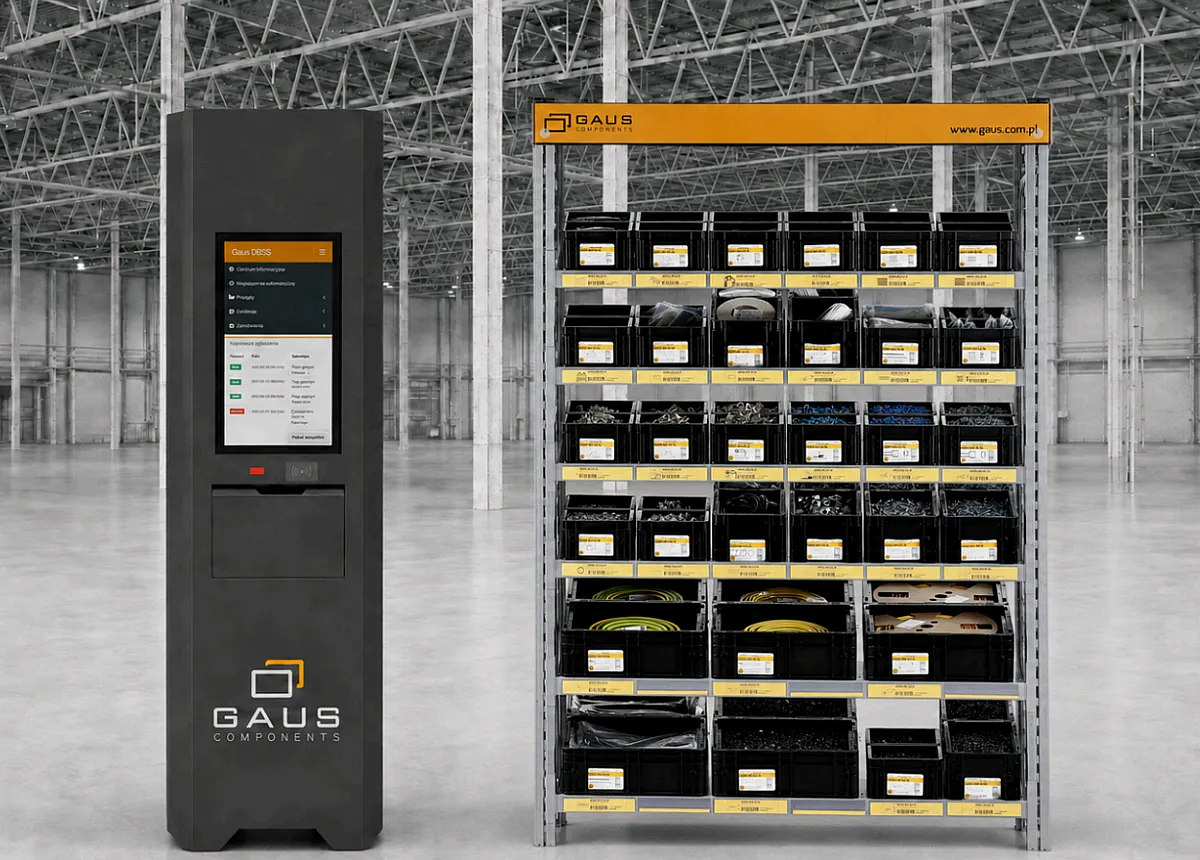
The assortment was divided into three distribution channels: vending machines, a Kanban supermarket and a Mobile Demand Reporting Point.
A shared DBSS and VMI layer connects vending machines, the Kanban supermarket and the infokiosk into one data model and one operational process.
Full control of the supply process without placing the entire assortment in vending machines and without unjustified cost increases.
Context: the customer wanted to cover the entire assortment with vending machines
The starting point was a typical challenge faced by a production plant operating in a shift system. Employees used a wide range of materials: small production components, fasteners, electrical accessories, personal protective equipment, tools, consumables and products with larger or irregular dimensions.
The first concept assumed the broadest possible use of vending machines. The assumption was logical: if a machine identifies the user, records the withdrawal and provides 24/7 access, it would seem best to place all products in it. However, the analysis showed that this approach would increase the investment cost without a proportional improvement in control or availability.
This description is a model, anonymous case study based on the realities of typical industrial projects. It does not present the financial results of a specific customer and does not declare unverified savings.
The problem was not the technology, but matching the technology to the product
The vending machine was a very good solution for part of the item range, but not for the entire assortment. The limitations became visible in three product groups:
- Low-value items with very high rotation — they would take up a large part of the machine capacity, require frequent replenishment and make the cost of recording each single withdrawal disproportionate to their value.
- Large, heavy or irregular products — they did not fit into standard compartments or would use them inefficiently.
- Rarely withdrawn products — they required control, but reserving a permanent compartment for them had no economic justification.
The most expensive control method should not handle the cheapest products.
The project team therefore changed the question. Instead of asking how many machines would be needed to cover the entire assortment, it defined what level of control was required for each product group and which distribution channel would provide it at the lowest cost.</p>
Not sure which products should be placed in a vending machine?
We can segment your assortment by value, rotation, size and required control level.
Solution: three distribution channels, one process
The assortment was segmented by product value, rotation, dimensions, the need for user identification and the consequences of a potential shortage. This resulted in a hybrid architecture consisting of three complementary channels.
1. Vending machines – full control at the point of withdrawal
The machines were assigned to products that are more expensive, sensitive, require limits, need to be assigned to a specific user or require return registration. The vending machine provides 24/7 access and automatically records the operation. Its capacity is used where a digital trace of each withdrawal truly creates value.
2. Kanban supermarket – high volumes at a low handling cost
Low-value, small and fast-moving items were directed to a production-side supermarket. A one-bin or two-bin system makes it possible to replenish stock based on actual consumption. There is no need to identify every employee taking a single screw, cable tie or marker — control takes place at the level of the container, item index and point of use.
3. Mobile Demand Reporting Point – control without a compartment
For oversized products, items withdrawn less frequently or products requiring special supervision, an infokiosk was used. The employee authorizes themselves, selects the product and quantity, and assigns the request to an order, department or cost center. A GAUS employee picks and delivers the material, and the completion is recorded in the system.
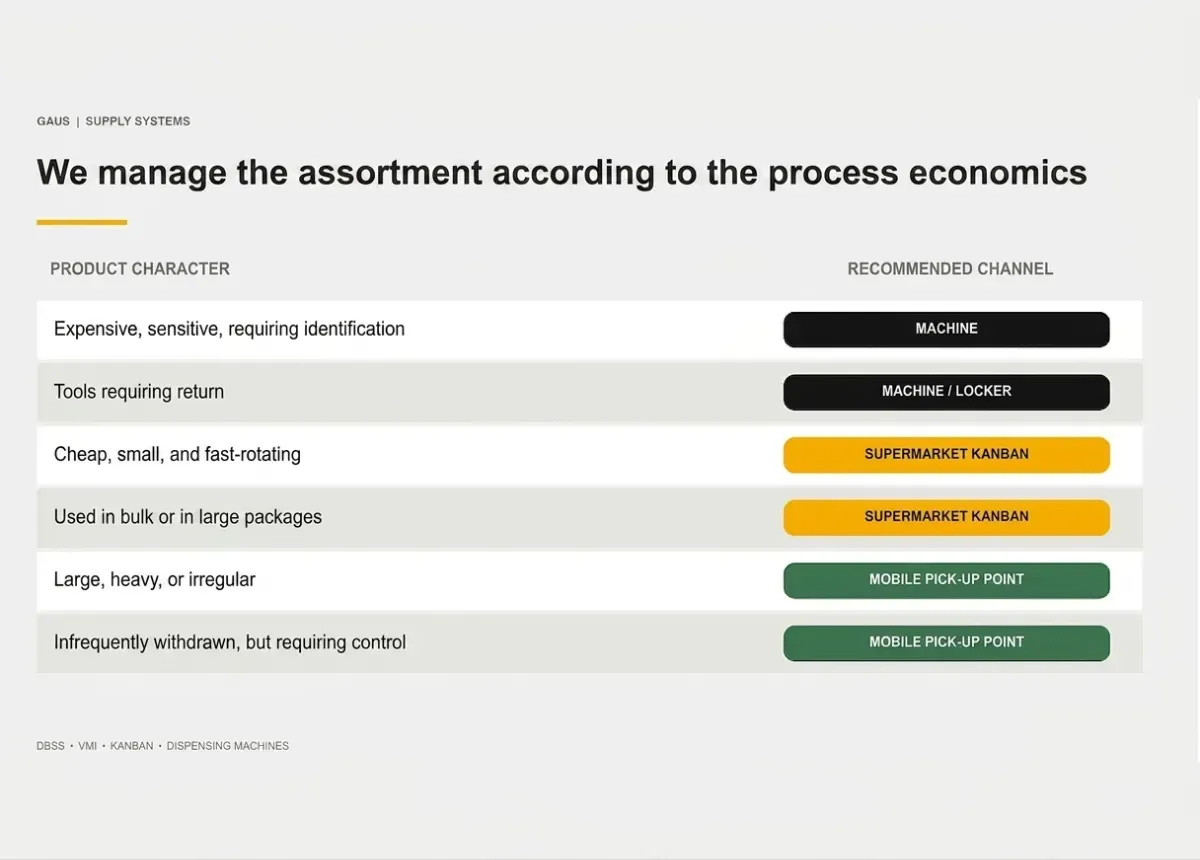
Example assortment segmentation based on process economics.
How does the Mobile Demand Reporting Point work?
The solution preserves the most important function of a vending machine — operation traceability — without requiring the product to be physically placed in the device:
- The employee authorizes themselves at the infokiosk.
- They select the product, define the quantity and indicate the cost center.
- DBSS records the request and forwards it for execution.
- A GAUS employee picks and delivers the requested product.
- Confirmation of issue closes the operation and leaves a full trace in the system.
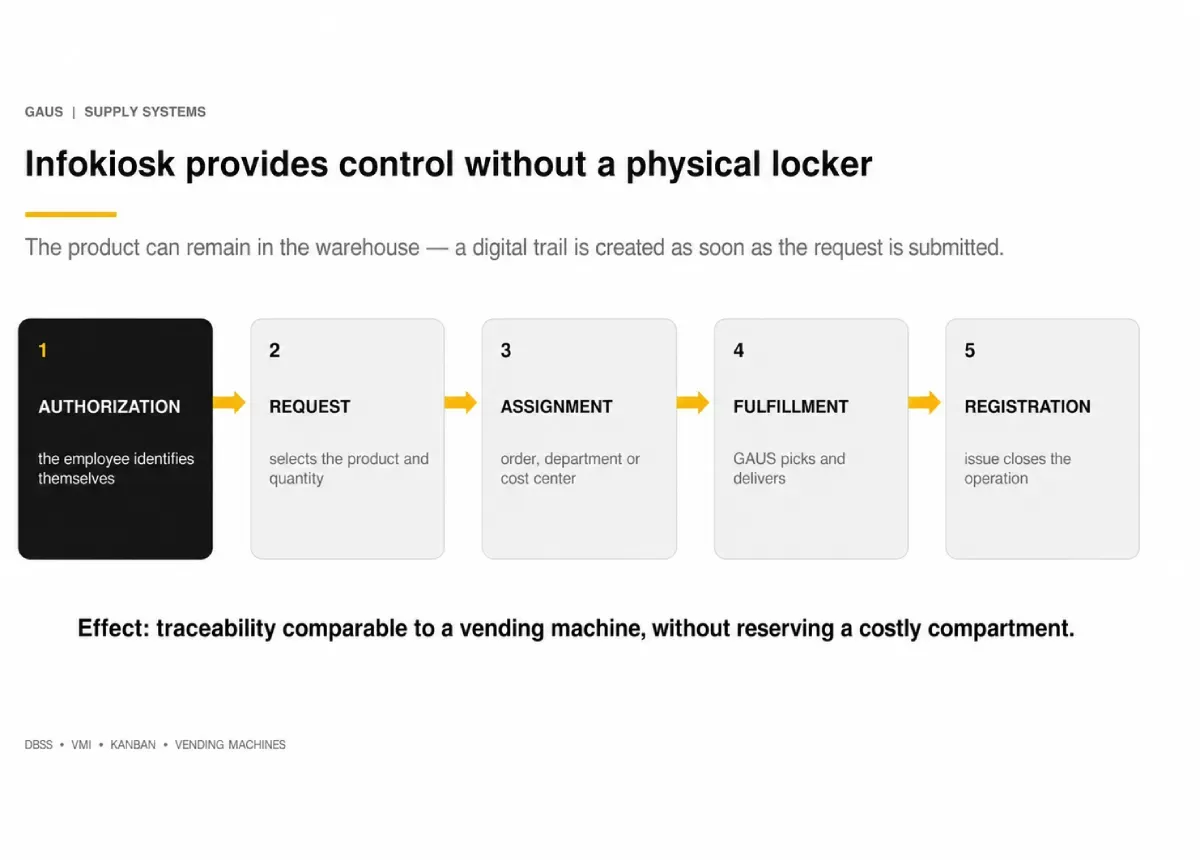
A digital trace of the withdrawal is created without the need to reserve an expensive vending machine compartment.
DBSS and VMI eliminate the risk of three inconsistent “islands”
The greatest value of the solution is not only the combination of three channels. The key point is that vending machines, the Kanban supermarket and the infokiosk operate within one data model and under shared GAUS operational responsibility.</p>
- All channels use common product master data and cost allocation rules.
- DBSS collects data on stock levels, withdrawals, requests and replenishment execution.
- VMI allows GAUS to take agreed responsibility for stock availability.
- Automatic signals and defined replenishment parameters reduce manual checks and urgent orders.
- One process operator eliminates disputes over whether a shortage is caused by the device, the system, the warehouse or the supplier.
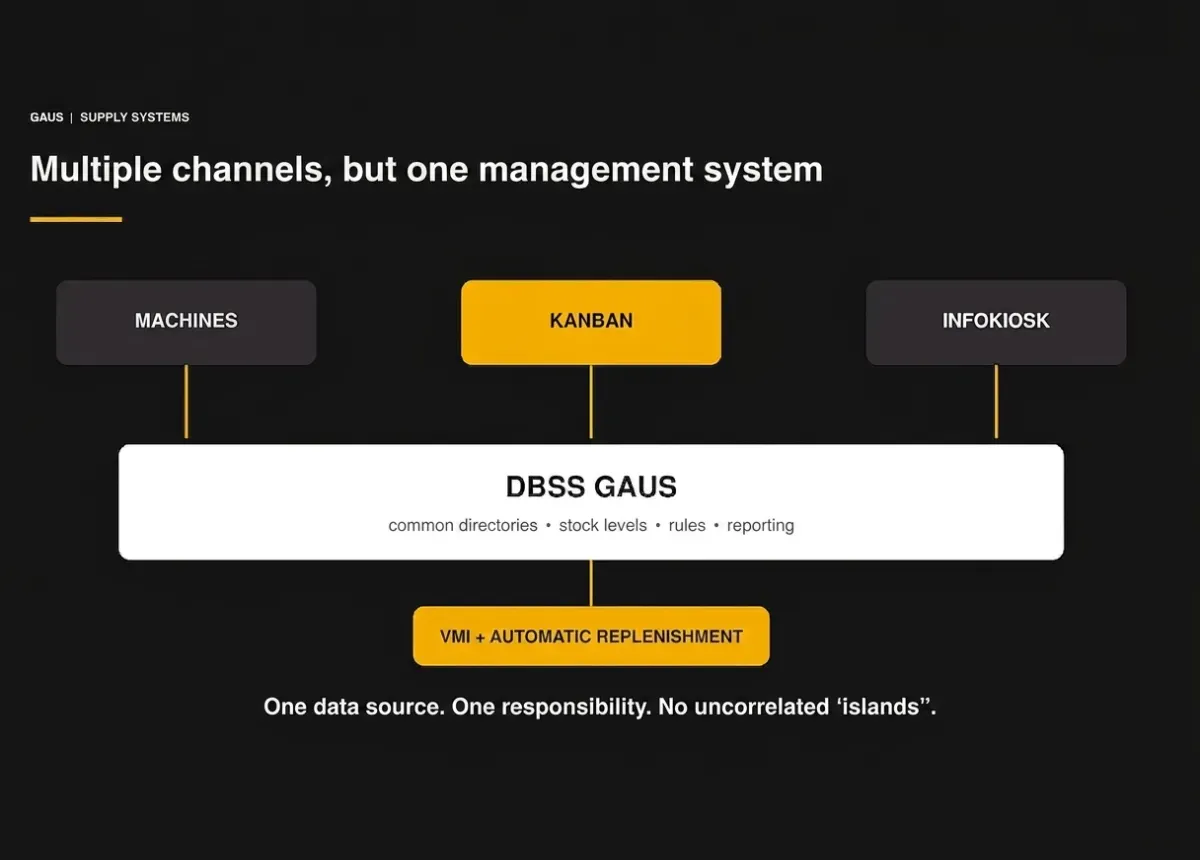
A shared DBSS and VMI layer connects different distribution methods into one supply process.
Profitability assessment: we calculate the handling cost of an item index, not the number of devices
In the hybrid model, the decision to place a product in a machine does not depend only on whether it technically fits into a compartment. The total handling cost of the item index is analyzed, including:
- the cost of the machine, software and available capacity,
- the replenishment frequency and labor cost related to loading,
- the product value, rotation and number of transactions,
- the cost of a potential material shortage,
- the value of information obtained from recording a single withdrawal.
A machine is justified when the value of detailed control exceeds the cost of automation. Kanban is appropriate when the priority is a smooth flow of large quantities of low-value product. The infokiosk fills the space between these solutions: it provides authorization and traceability without the cost of a physical compartment.
Result of the solution
The hybrid implementation makes it possible to include the entire assortment in the process, even if only some products are placed in vending machines. The benefit does not come from simply reducing the number of devices, but from better matching the distribution method to the nature of the product.
- Products requiring strict control remain available 24/7 in vending machines.
- Low-value and fast-moving components are available without unnecessary barriers in the Kanban supermarket.
- Oversized and less frequently withdrawn products retain a full operational trace thanks to the infokiosk.
- DBSS and VMI provide shared data, automatic replenishment and clear responsibility for the process.
Full process automation does not require placing the entire assortment in vending machines.
Conclusions for production plants
Before purchasing vending machines, it is worth carrying out assortment segmentation. The key question is not: “how many products will fit into the machine?”, but: “what form of control is economically justified for a given product?”.
The GAUS approach makes it possible to build the system in modules. Machines remain an important part of the solution, but they are not used where a Kanban supermarket or a Mobile Demand Reporting Point can provide the same business effect at a lower cost.
How to start the analysis?
The first step should be an audit of item indexes, rotation, dimensions, points of use, the expected level of traceability and the consequences of shortages. On this basis, GAUS can design the assortment split, select devices and Kanban parameters, and configure request handling in DBSS.
The most expensive control method should not handle the cheapest products.
Frequently asked questions
Should the entire assortment be placed in vending machines?
Not always. Vending machines work best for products that require strict control, limits, user identification or return registration. Low-value, fast-moving or oversized products can often be handled more effectively through a Kanban supermarket or a Mobile Demand Reporting Point.
What is the GAUS hybrid supply system?
It is a combination of vending machines, a Kanban supermarket and a Mobile Demand Reporting Point into one process based on a shared DBSS and VMI layer.
Why can a Kanban supermarket be better for low-value products?
For low-value and fast-moving components, the cost of recording every single withdrawal may be disproportionate to the product value. Kanban controls stock at the level of the container, item index and point of use, without unnecessary barriers for employees.
What role does DBSS play in this model?
DBSS collects data on stock levels, withdrawals, requests and replenishment execution. As a result, different distribution channels do not operate as separate islands, but as one coherent supply process.
Want to turn this knowledge into a practical process?
Use the C-Parts procurement audit or explore the interactive supply process map to better assess cooperation opportunities with GAUS Components.